Every year around results season, a version of the same conversation plays out in our office. A nervous parent, a bright but unsure student, and one question that hangs in the air before we've even sat down:
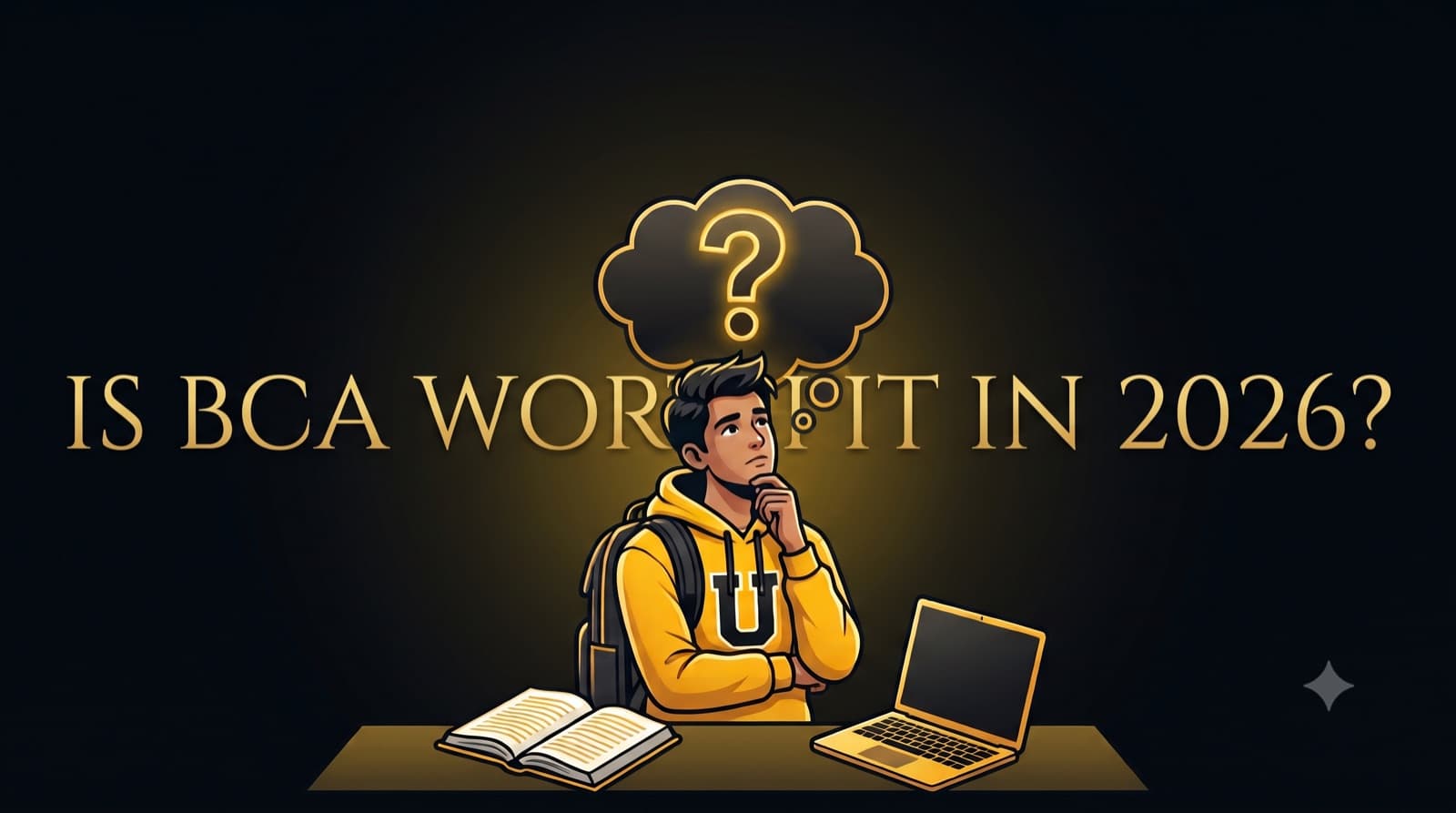
“Sir, is BCA still worth it — or will AI take all these jobs?”
It's a fair question, and an important one. We've spent years building a computer science program, sitting across from hiring managers, and watching where our students actually end up. So instead of the usual “BCA is booming, join now!” answer you'll find everywhere online, here is the honest version we give the families in front of us.
Quick answer: Yes — a BCA is still worth it in 2026, but only if you add real AI, data, or cloud skills on top of the degree. On its own, a plain 3-year BCA now leads to crowded, lower-paying jobs (around ₹3–6 LPA). BCA graduates who learn Python, AI/ML, and cloud, and who build real projects, are still getting hired at ₹5–10 LPA. The degree hasn't lost its value — but the “just pass and get placed” era is over.
Let me explain why we believe that, with the numbers and the jobs — and what it means for the choice you're about to make.
Why students keep asking if BCA is worth it
I understand the worry. Every week there's a new headline about AI writing code, and it's easy to assume a computer degree is now a risky bet. But we see the market from the other side — the hiring side — and the picture is more hopeful, and more specific, than the panic suggests.
The Bachelor of Computer Applications is a 3-year degree focused on practical software and IT skills: programming, databases, web development, and networking. You can join after Class 12 from any stream, usually with 45–50% marks and no JEE. It's cheaper than B.Tech and gets you into the IT job market quickly. Those advantages are all still real in 2026.
What has changed is the entry level. AI tools can now write basic code, run simple tests, and handle routine IT support. So the easiest, lowest-skill jobs a BCA used to guarantee are shrinking. But — and this is the part families rarely hear — demand for people who can build with AI is rising fast. The World Economic Forum's Future of Jobs Report 2025 lists AI, machine learning, and data roles among the fastest-growing jobs in the world, and puts AI and big-data skills at the very top of its most-wanted list.
So the real question isn't “Is BCA dead?” It's “Will your BCA give you AI-era skills or not?” That single distinction decides everything.
BCA salary in 2026: the numbers we show parents
When parents ask about money, we don't give them one flattering “average.” We show them the full spread, because the spread is the real story. Here are realistic fresher salaries for BCA graduates in India for 2025–26.
- IT support / helpdesk — Salary in 2026 (LPA): 2.5–4.5 · What lifts it: Certifications, communication
- QA / software tester — Salary in 2026 (LPA): 3–6 · What lifts it: Automation testing skills
- Junior software developer — Salary in 2026 (LPA): 3.5–7 · What lifts it: Strong coding, DSA, projects
- Web / full-stack developer — Salary in 2026 (LPA): 4–8 · What lifts it: React, Node, live projects
- Cybersecurity analyst — Salary in 2026 (LPA): 4–9 · What lifts it: CEH or security certifications
- Cloud / DevOps engineer — Salary in 2026 (LPA): 5–9 · What lifts it: AWS, Azure or GCP certification
- AI/ML junior / support — Salary in 2026 (LPA): 5–9 · What lifts it: Python + ML libraries, projects
- Data analyst — Salary in 2026 (LPA): 5–10 · What lifts it: SQL, Python, dashboards
- After MCA (later) — Salary in 2026 (LPA): 7–15 · What lifts it: Master's + specialisation
Salary ranges are based on 2025–26 India hiring data compiled by ISMT. They're indicative national figures — metro cities like Bengaluru, Pune and Hyderabad pay roughly 20–30% more than tier-2 cities, though living costs are higher too. Always check a college's real placement records before you enrol. [Insert Quad's own latest placement range here — your real numbers are far more convincing than any national average.]
Look at that top row and bottom row. A plain IT-support job pays about half of what a data or cloud role pays. And every high-paying line needs a skill beyond the basic BCA syllabus. When I point this out to a parent, the conversation changes — because now we're not debating whether BCA is “good,” we're talking about how to land in the top half of that table. That's the only question worth answering.
Will AI replace BCA jobs?
This is the one everyone is afraid to answer straight, so I will: AI is replacing tasks, not the whole career — but it is changing which BCA graduates get hired.
Here's what we actually see. AI coding tools are very good at the simple, repetitive work that used to be a fresher's first job — basic functions, small bug fixes, standard tests, routine IT tickets. Our hiring partners now expect one skilled person, helped by AI, to do what used to need a small team of juniors. So yes, the lowest-skill entry jobs are getting fewer.
But the same shift is creating new work, and a lot of it. Someone has to build, connect, test and secure these AI systems, handle the data behind them, and run the cloud they live on. In India, a NASSCOM–Deloitte report expects AI jobs to grow from about 6.5 lakh in 2022 to more than 12.5 lakh by 2027. NASSCOM also reports a gap of around 51% between the AI talent companies need and the people actually available (NASSCOM).
Read that again: there is a shortage of skilled people, not a shortage of jobs. That is the single most important fact for a student in 2026. Our advice is simple — don't fight AI for the jobs it's taking. Go where it's creating demand: AI/ML, data, cloud, and security. And prove you can do the work with real projects.
BCA scope: the jobs our students actually get
Set aside the theory — here are the roles a BCA realistically opens in 2026:
-
Software and web development — still the biggest hiring area, from internal tools to customer apps.
-
Data analyst / business intelligence — turning data into decisions with SQL, Excel and Python; one of the fastest-growing fields.
-
Cloud and DevOps — running the servers and pipelines behind modern software; a certification is a real edge.
-
Cybersecurity — defending systems from attacks; one of the best-paying entry areas with the right certification.
-
AI/ML support roles — data preparation, model testing and integration, especially at startups and mid-size firms.
-
Non-coding tech roles — QA, technical writing, IT sales, product support and UI/UX for students who prefer less code.
Big recruiters of BCA graduates include TCS, Infosys, Wipro, HCL, Cognizant, Tech Mahindra, Capgemini and Accenture, plus banks, fintechs and e-commerce firms. And the degree isn't a dead end — you can go on to an MCA or an MBA in IT, or clear government and PSU exams.
Best BCA specialisations in 2026
If your BCA lets you specialise or add skills, these four give the best return, in the order we'd recommend them:
-
AI & Machine Learning — the most future-proof choice. Python, ML libraries and data handling put you exactly where demand is highest.
-
Data Science & Analytics — every industry runs on data now; strong SQL and Python skills pay from day one.
-
Cloud Computing — India's cloud market is growing fast; AWS, Azure or GCP certifications open cloud and DevOps roles.
-
Cybersecurity — rising cyberattacks mean every company needs defenders; certifications like CEH lift your salary quickly.
The lesson we repeat to every batch: the specialisation matters as much as the degree. A plain BCA and a BCA backed by AI or cloud skills lead to very different lives.
BCA vs B.Tech vs BSc CS: which is better in the AI era?
Parents always ask us to compare, so here's the honest table — no spin.
- Duration — BCA: 3 years · B.Tech CSE: 4 years · BSc Computer Science: 3 years
- Entrance — BCA: Merit / CUET, no JEE · B.Tech CSE: JEE or state exam · BSc Computer Science: Merit
- Focus — BCA: Practical apps, coding, IT · B.Tech CSE: Deep CS, maths, engineering · BSc Computer Science: Theory + programming
- Cost — BCA: Low · B.Tech CSE: Higher · BSc Computer Science: Low–moderate
- Typical fresher pay — BCA: ₹3–6 LPA · B.Tech CSE: ₹4–12+ LPA · BSc Computer Science: ₹3–6 LPA
- AI-era edge — BCA: Needs added AI/data skills · B.Tech CSE: Built-in depth (esp. AI/ML) · BSc Computer Science: Needs added skills
- Best for — BCA: Fast, low-cost entry to IT · B.Tech CSE: Core tech, higher ceiling · BSc Computer Science: Further study or research
B.Tech CSE has the highest salary ceiling and the most built-in depth — especially programs that specialise in AI and ML. BCA is faster and cheaper and still leads to good IT careers, if you add the right skills. BSc CS sits in between and suits students planning higher studies.
If you're still weighing everything after Class 12, our companion guide to the highest-salary courses after 12th in 2026 lays all the routes and their pay side by side.
When a BCA is worth it — and when it isn't
I'll give you the same blunt test I give students who sit in our office.
A BCA is worth it if you:
-
Pick a college for its real placements and industry training — not just its syllabus.
-
Add AI/ML, data, or cloud skills through certifications and projects.
-
Build a project portfolio on GitHub and do at least one real internship.
-
Are happy starting in IT services and growing your skills fast.
Think twice if you:
-
Expect the degree alone to get you a high-paying job — it won't in 2026.
-
Pick a college with weak placements and an outdated syllabus.
-
Want to walk straight into top product companies like Google or Microsoft, which usually want stronger degrees and deep problem-solving at entry level.
Why we built Quad the way we did
I'll be honest about where this comes from. We kept meeting the same student: smart, hard-working, three years into a BCA — and stuck, because nobody had taught them the AI, data, or cloud skills the market was actually paying for. The degree was fine. The preparation was missing.
That gap is the reason Quad exists. We didn't want to run one more college that hands out a certificate and hopes for the best. So we built a 4-year Computer Science (AI & ML) program that puts the AI-era skills — the ones in that salary table — at the centre, and wraps them in the things that actually get students hired: live projects from day one, a mandatory 6-month paid internship, mentorship from people who've worked at companies like Google, Microsoft and Amazon, and a curriculum shaped with IIT and IIM alumni. And we planted our campuses in Mangalore and Patna, on purpose — because talent in these cities is every bit as good, and it deserves a program that treats it that way.
If a BCA appeals to you because it's practical, hands-on and job-first, that instinct is right — that's exactly how learning should feel. Our 4-Year Computer Science (AI & ML) program gives you that same practical spirit, plus the AI depth, the degree, and the internship that protect your salary as AI reshapes the industry.
Want the practical, job-first route into tech — but AI-proofed? See QuadCSE's Computer Science program →
The bottom line — from us to you
So, is BCA worth it in the AI era? Yes — but with a condition it didn't carry a few years ago. AI has raised the bar. The degree alone won't carry you, but a BCA backed by real AI, data, or cloud skills and genuine projects still leads to a strong, well-paid tech career. Choose your college for its placements and training, add the skills AI is creating demand for, and prove them with real work. Do that, and BCA — or a stronger AI-first alternative — is absolutely worth it.
We tell every family the same thing: don't pick a course, pick an outcome — then choose the path that gets you there.
Deciding your path after 12th? Explore QuadCSE's 4-Year Computer Science (AI & ML) program — practical and job-first like a BCA, but with AI depth, a paid internship, and 100% placement support at our Mangalore and Patna campuses. Take the first step →