Quick answer: In 2026, AI/ML salaries in India range from ₹6–15 LPA for freshers to ₹22–52 LPA at mid-to-senior levels, with top specialists in Generative AI, LLMs, and MLOps crossing ₹80 LPA. Pay is driven less by your degree and more by your skills, your production project portfolio, and your specialisation. This guide breaks down what you can earn — by role, city, and experience — and, more importantly, how to actually get there.
If you are a student choosing a course, a parent evaluating where a four-year investment leads, or a fresher planning your next move, this is the number-first, no-fluff picture of the AI/ML job market in 2026.
Why AI/ML salaries are climbing in 2026
Before the numbers, understand the force behind them: demand is growing far faster than the supply of skilled people. That imbalance is what pushes packages up.
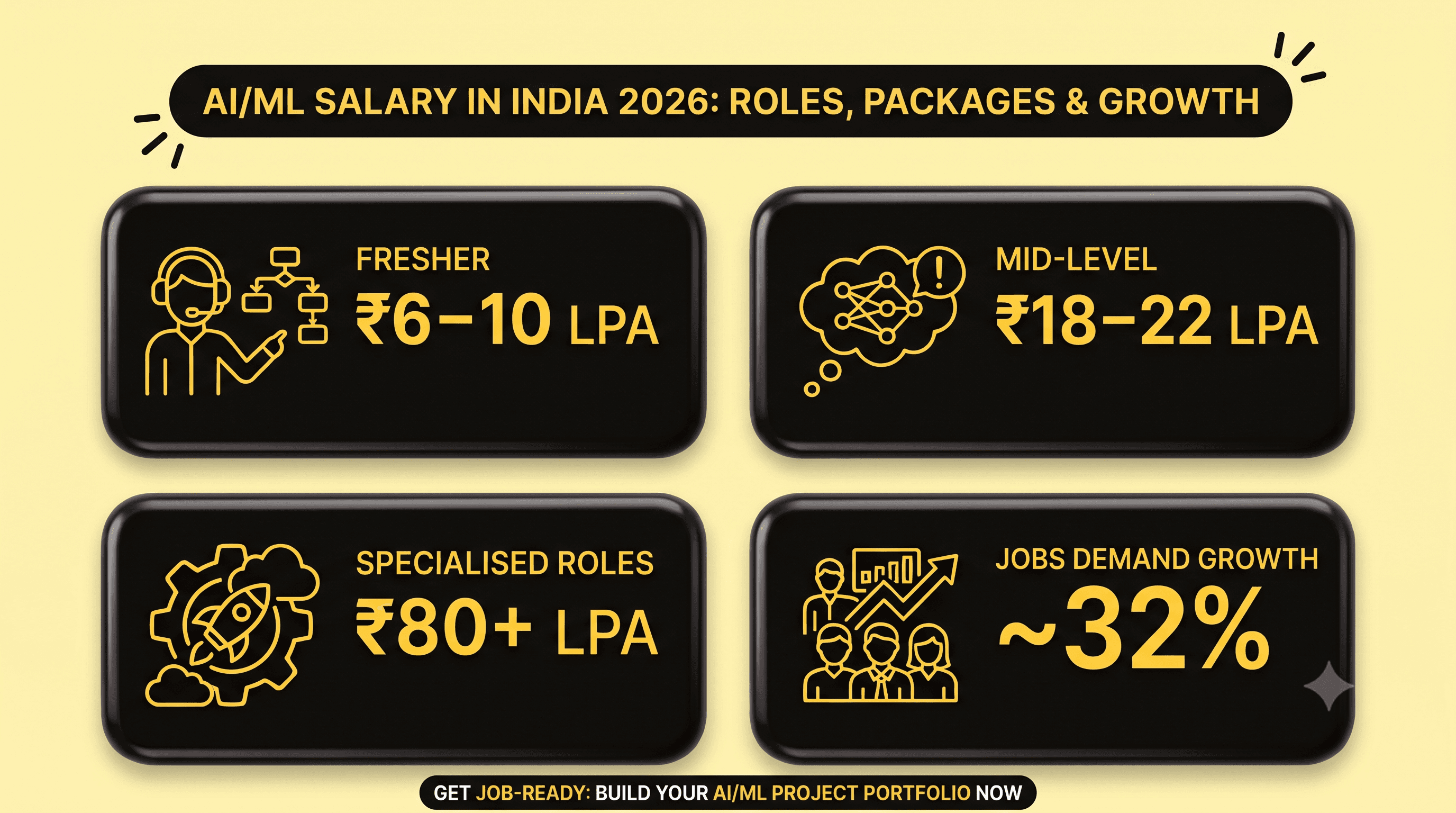
- AI-linked job postings in India hit 290,000+ in 2025 and are projected to grow ~32% in 2026 to nearly 3.8 lakh roles, per the foundit hiring report.
- Demand for Generative AI and LLM skills surged ~60% year-on-year — the fastest-growing skill category in the country.
- 82% of Indian employers report difficulty filling roles in 2026 (ManpowerGroup) — roughly one qualified GenAI engineer for every ten open positions.
- India will need close to one million skilled AI professionals, and the World Economic Forum highlights India as a global driver of GenAI talent demand.
The takeaway is simple: this is a scarcity market, and scarcity markets reward the people who show up job-ready. That is a window — and windows close.
Average AI/ML salary in India by experience (2026)
- Fresher (0–2 yrs): average ₹6–10 LPA · top 25% ₹15 LPA · top 10% ₹22 LPA — hiring: Google, Microsoft, Flipkart, Razorpay
- Mid-level (2–5 yrs): average ₹18–22 LPA · top 25% ₹30 LPA · top 10% ₹40 LPA — hiring: Amazon, PhonePe, Meesho, Walmart
- Senior (5–8 yrs): average ₹35–38 LPA · top 25% ₹48 LPA · top 10% ₹60 LPA — hiring: Meta, MS Research, Swiggy, Groww
- Lead (8+ yrs): average ₹50–52 LPA · top 25% ₹65 LPA · top 10% ₹80 LPA — hiring: Google, Uber India, NVIDIA India
Sources: foundit, Glassdoor, AmbitionBox and market hiring data, 2026. At senior levels ESOPs and variable pay add significantly on top.
Notice the shape of this curve: the jump from fresher to mid-level is the steepest of any tech track in India. A strong start compounds fast. A well-built fresher portfolio is worth more than years of average work — NASSCOM data shows AI/ML fresher hiring grew 22% year-on-year, and strong freshers with Python, PyTorch, and real deployed projects negotiate ₹10–15 LPA at product companies.
AI/ML salary in India by role (2026)
Not all AI roles pay the same. Specialisation is where the real money separates.
- AI Engineer — ₹6–15 LPA
- Machine Learning Engineer — ₹7–40 LPA
- Data Scientist — ₹7–80 LPA
- MLOps Engineer — ₹8–45 LPA
- Computer Vision Engineer — ₹30–70 LPA
- NLP Engineer — ₹22–80 LPA
- Prompt / Applied AI Engineer — ₹9–60 LPA
- Generative AI / LLM Engineer — ₹20–70+ LPA
- AI Research Engineer — ₹30–200 LPA
The pattern is clear: generalist ML pays well, but GenAI, LLMs, computer vision, and research pay exceptionally. GenAI engineers earn a 20–40% premium over traditional ML engineers because the skill is scarce and the business impact is immediate.
City-wise AI/ML salary in India
- Bengaluru — ₹8–80 LPA (+25% vs national average)
- Hyderabad — ₹8–62 LPA (+18%)
- Mumbai — ₹8–65 LPA (+15%)
- Delhi / NCR — ₹8–55 LPA (+8%)
- Pune — ₹7–45 LPA (at average)
- Chennai — ₹7–42 LPA (−5%)
- Remote — ₹10–75 LPA (aligned to company HQ band)
Bengaluru remains the clear leader, holding roughly a 26% share of all AI jobs, while Hyderabad is the fastest-growing Tier-1 hub. Notably, Tier-2 cities like Jaipur, Indore, and Mysuru are emerging as genuine AI talent centres — proof that opportunity is spreading beyond the metros.
Salary by industry and company type
- SaaS / Product companies — ₹12–75 LPA (+25% vs market average)
- Fintech — ₹14–65 LPA (+20%)
- Healthcare AI — ₹14–60 LPA (+15%)
- E-commerce — ₹12–55 LPA (+10%)
- Startups (seed–Series B) — ₹8–45 LPA (equity-heavy)
- IT Services / Consulting — ₹6–28 LPA (−20%)
Product and SaaS companies pay the most because AI is their product, not a support function. Fintech's risk and fraud ML roles often match SaaS at the top end.
The skills that command the highest packages
The market rewards a specific stack in 2026. If you build these, you price yourself into the top bands:
- Python & SQL — the non-negotiable foundation.
- Machine Learning & Deep Learning — with hands-on TensorFlow / PyTorch.
- Generative AI & LLMs — fine-tuning, RAG, and building real GPT-style apps. The highest-leverage skill of the year.
- MLOps & Cloud (AWS / Azure / GCP) — deploying and scaling models in production, not just notebooks.
- Production experience — models running in live systems separate a ₹10 LPA offer from a ₹22 LPA one.
Gartner projects that four out of five engineers will need to upskill by 2027 to stay relevant in a GenAI-shaped world. The people who move now capture the scarcity premium. The people who wait compete for it later.
What actually affects your AI/ML salary
- Production ML experience — deployed, maintained, at scale.
- Specialisation — GenAI, LLMOps, and computer vision command 20–40% premiums.
- Company tier — product firms and unicorns pay 2–3x IT services for the same experience.
- Portfolio over pedigree — 73% of Indian employers hire freshers on demonstrated skills, not degrees.
- Location — Bengaluru, Hyderabad, and Mumbai lead; remote roles now pay near-metro bands.
- Continuous learning — the fastest-changing skill set in the market rewards those who keep pace.
How to maximise your AI/ML salary — the realistic roadmap
You do not need a legacy elite degree to earn well in AI. You need the right five things, in the right order:
- Master the in-demand stack (Python, ML/DL, GenAI, cloud) — deep enough to build.
- Ship real projects. Build your own ChatGPT-style app, a recommendation engine, a CV tool — deployed and public.
- Do a real internship. Nothing accelerates a package like proof you have worked on production systems.
- Build a visible portfolio on GitHub that a recruiter can open and immediately trust.
- Get mentored by people already inside the companies you want — they know exactly what gets you hired.
This roadmap is the difference between knowing about AI salaries and earning one. The hard part is doing all five, consistently, with the right guidance — which is exactly the gap a well-designed undergraduate program closes.
The fastest structured path in: B.Tech CSE (AI & ML) at Quad
Most colleges teach AI as theory and hope placements follow. Quad AI's B.Tech CSE (AI & ML) was built backwards — from the salary outcome to the curriculum. Here is why that matters for your package:
- Learn from the people who set the salary bands. 75% of faculty are CXOs, founders, and engineers from Google, Microsoft, Amazon, Meta, and Apple, with a curriculum co-designed by IIT and IIM alumni.
- 100,000+ lines of production code before you graduate. You build real applications from day one — including your own version of ChatGPT.
- A mandatory 6-month paid internship, plus a "learn and earn" model where students start earning from their second year.
- Curriculum built for the high-paying stack: Machine Learning, Deep Learning, Generative AI, LLMs, GPT models, and Cloud Computing.
- 100% placement support — resume building, mock interviews with MAANG engineers, and direct recruiter connections.
- No JEE required. Admission is through the Quad Aptitude Test (QAT) and a personal interview — merit and mindset over rote ranks.
"I joined Quad with confusion, but today I feel confident. The complex theories from lectures finally clicked into real-world projects." — Quad B.Tech CSE (AI & ML) student
Scholarships (and why timing matters)
Quad offers 10%–50% scholarships, including up to 50% for women and early-bird entries. Early-bird slots are limited by intake — the students who enquire first lock in the best support.
How admission works (three simple steps)
- Apply online with your academic details on the Quad website.
- Take the QAT — a 60-minute online aptitude test (reasoning, quantitative, communication).
- Attend a personal interview — and you're automatically considered for scholarships.
Eligibility is 10+2 with PCM and a minimum of 50%. Education loans and semester-wise payment plans mean finance is not a barrier.
Future outlook: is AI/ML a safe bet beyond 2026?
Yes — and the data is unusually clear. AI hiring is growing 30%+ annually, demand is spreading from IT into BFSI (+41%), healthcare (+38%), retail, and logistics, and the PwC 2026 Global AI Jobs Barometer finds AI-exposed roles seeing 42% faster wage growth than the rest of the market. The scarcity premium may narrow by 2027 as more people train up — which is precisely why entering now, with a job-ready skill set, is the smart move.
Salary figures are indicative 2026 market ranges compiled from foundit, Glassdoor, AmbitionBox, NASSCOM, ManpowerGroup, PwC, and WEF reporting, and vary by skills, company, and location.