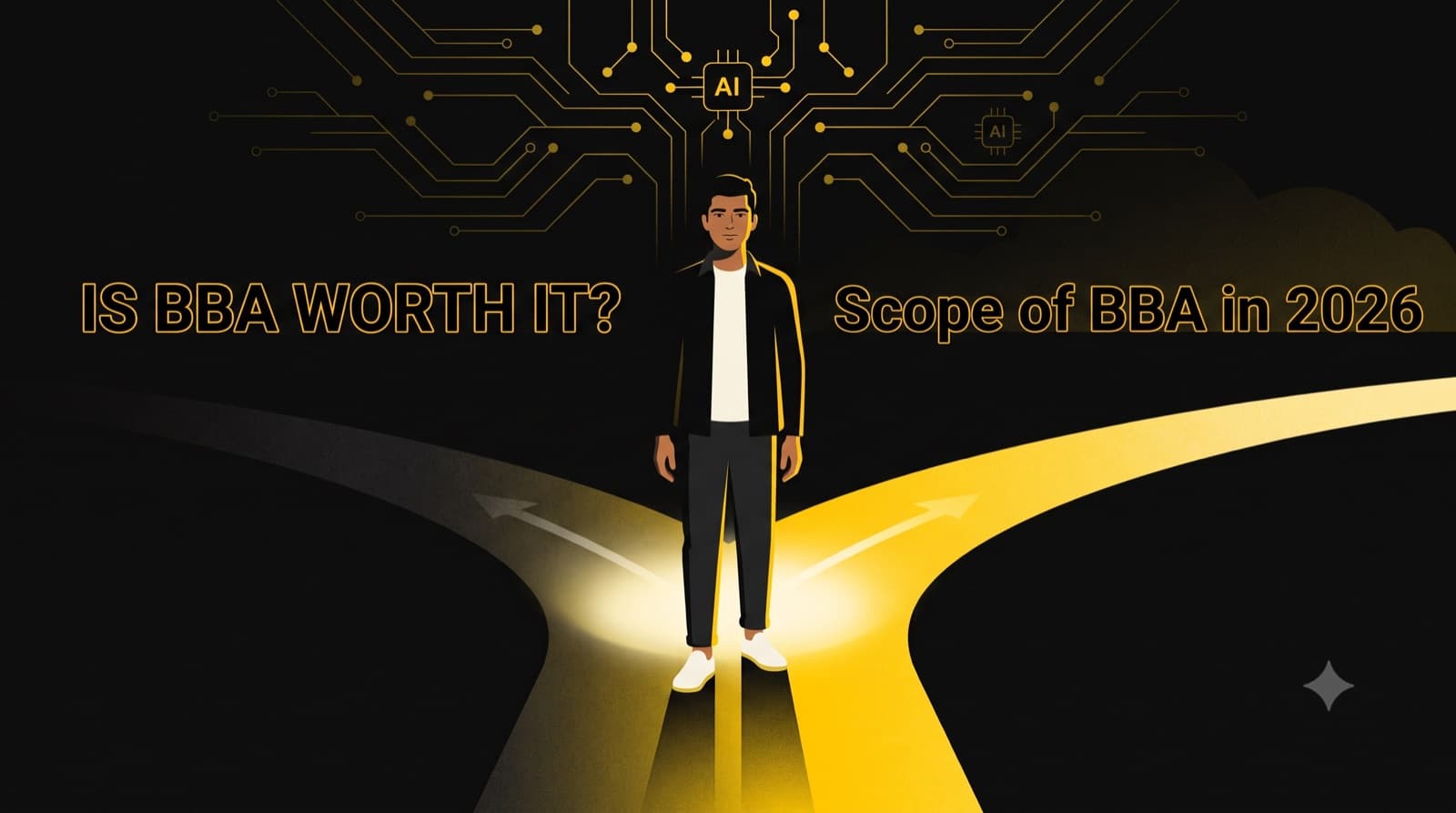
It's 11 p.m. in a flat in Kankarbagh, Patna. Riya has just finished her Class 12 commerce boards. Her results were good — 88%. Her father wants her to "do CA, beta, it's the safest." Her mother has already told three relatives that Riya is "going for CA." And Riya is lying awake, scrolling through Instagram reels of 24-year-olds earning in lakhs, feeling like everyone has a plan except her.
She has questions she's afraid to ask out loud:
- What if I start CA and can't clear it? (She's heard the pass rates are brutal.)
- Is BBA a "timepass degree," like her chachu keeps saying?
- If I want a good salary, do I have to leave Patna?
- And these new-age colleges everyone's talking about — are they real, or are they just good at marketing?
If you're a commerce student — or the parent of one — this article is for that 11 p.m. version of you. We're going to walk through the best courses after 12th commerce, what they actually pay in 2026, and how to pick a path that leads somewhere. No hype. Just the map. (If you'd like to browse real options as you read, here's the full list of Quad's programmes.)
Quick answer (for the impatient): For most commerce students in 2026, the highest-earning paths are CA, a BBA specialised in Business Analytics or Finance, and finance certifications like CFA/CMA layered on a degree. But here's the part nobody puts on the poster: your course name matters far less than whether your degree builds analytical + digital skills and gets you real internships. A BBA that does that will out-earn a generic B.Com every single time.
What are the best courses after 12th commerce in 2026?
Let's start with the honest shortlist. These are the courses commerce students actually choose, with realistic 2026 salary bands and who each one suits.
- BBA (with a strong specialisation) — Duration: 3 yrs · Maths needed?: No · Best for: Future managers, founders, analysts · Fresher salary (approx.): ₹3–6 LPA · Ceiling with experience: ₹15–25 LPA
- B.Com (Hons.) — Duration: 3 yrs · Maths needed?: Optional · Best for: Foundation before CA/MBA · Fresher salary (approx.): ₹3–5 LPA · Ceiling with experience: ₹12–15 LPA
- CA (Chartered Accountancy) — Duration: 4–5 yrs · Maths needed?: Helpful · Best for: Disciplined number-lovers · Fresher salary (approx.): ₹6–10 LPA · Ceiling with experience: ₹25 LPA+
- CMA / CS — Duration: 3–5 yrs · Maths needed?: Helpful · Best for: Costing / compliance careers · Fresher salary (approx.): ₹4–7 LPA · Ceiling with experience: ₹20 LPA+
- BBA LLB (Law) — Duration: 5 yrs · Maths needed?: No · Best for: Corporate law aspirants · Fresher salary (approx.): ₹5–10 LPA · Ceiling with experience: ₹18 LPA+
- Economics (Hons.) — Duration: 3 yrs · Maths needed?: Yes · Best for: Policy, research, analytics · Fresher salary (approx.): ₹4–7 LPA · Ceiling with experience: ₹15 LPA+
Salary figures are indicative 2026 ranges drawn from public salary data and vary widely by college, city, and skills. Treat them as ballparks, not promises.
Notice something? Almost every high ceiling in that table belongs to a path that either (a) is genuinely hard and selective, like CA, or (b) rewards analytical and business skills rather than rote knowledge — which is exactly what an AI-integrated degree like Quad's 3-year UG in Management is built around. Hold that thought.
Why is BBA suddenly one of the smartest commerce choices?
For years, the advice to commerce students was simple: "Do B.Com, then decide." BBA was seen as the softer, "management types" option. That advice is now a little outdated, and the reason is what's happening to jobs.
The World Economic Forum's Future of Jobs Report 2025 surveyed over 1,000 large employers. Two findings should stop every commerce student in their tracks:
- The fastest-declining jobs are classic commerce jobs. Bank tellers, cashiers, data-entry clerks, and — this one hurts — accountants and auditors are on the list of roles shrinking the fastest through 2030, as automation and AI take over routine work.
- The most in-demand skill on Earth is analytical thinking, called essential by 7 out of 10 employers, followed closely by AI and big-data literacy.
So the old "safe" commerce career — sit in a bank, process numbers — is exactly the kind of work getting automated. Meanwhile, the roles growing fastest need people who can analyse a business, not just record it.
A well-designed BBA sits right in the middle of this shift. It teaches you how a business actually works — marketing, finance, operations, people — and when it's paired with analytics and digital skills, it turns you into the kind of graduate employers are fighting over. That's why fresher packages for BBA in Business Analytics already run higher than a generic B.Com, and why analytics is consistently among the highest-paying specialisations, per Careers360's BBA salary data. India's own tech-and-data talent demand — tracked by industry body NASSCOM — keeps pulling business graduates with digital skills into higher-paying roles every year.
In short: BBA isn't the "easy" option anymore. Done right, it's the option that's aimed at where the jobs are going — not where they used to be.
How much can you actually earn after BBA or a commerce course?
Let's be real about numbers, because this is what keeps you up at night.
A BBA fresher in India in 2026 typically starts around ₹2.5–5 LPA in a general management role. That's the honest starting point, and it can feel modest. But two things change the picture fast:
- Specialisation. Freshers in Business Analytics or Finance often start at ₹3.5–6 LPA, and top performers with internships and certifications push past ₹6 LPA out of college.
- Time + skill. By years 5–7, many BBA graduates reach ₹10–18 LPA, and senior/leadership roles routinely cross ₹15–25 LPA, especially in fintech, consulting, and analytics-heavy companies.
CA remains the single highest-ceiling commerce path — qualified CAs earn from ₹6–10 LPA at entry to ₹25 LPA+ at senior levels. But it's a marathon with genuinely tough exams and a real chance you don't clear on the first attempt. That's not a reason to avoid it — it's a reason to go in with eyes open.
The pattern across every one of these paths is the same: your salary tracks your skills, your internships, and your city — far more than the name of your degree. A BBA graduate from a college with strong placements and real industry projects will out-earn a B.Com graduate who coasted. Every time.
CA vs BBA vs B.Com — which one should you actually pick?
Here's a simple way to decide, without the family drama:
- Pick CA if you genuinely enjoy accounting and taxation, you're disciplined enough to self-study for years, and you're okay with a long, hard road for a high payoff. (Tip: many students do B.Com alongside CA to hedge — check ICAI for the current structure.)
- Pick B.Com (Hons.) if you want a low-cost, flexible base and you plan to stack something on top — CA, CFA, an MBA, or a job in banking. On its own, a plain B.Com in 2026 is a starting line, not a finish line.
- Pick BBA if you're drawn to how businesses run — leading teams, marketing, strategy, analytics, or building your own thing someday — and you want a degree that's practical and internship-heavy from day one. This is where the ICP for this whole conversation usually lands.
There's no universally "best" course. There's a best fit. But once you've picked BBA, the next question is the one that actually decides your outcome: where do you do it?
"But I want a college in Patna or Mangalore with good placements"
This is Riya's real anxiety, and probably yours too. The dream isn't just "a BBA." It's "a BBA from a place that actually gets me a job, ideally without having to convince my parents to send me across the country."
Here's the uncomfortable truth about a lot of local private colleges: the degree is fine, but the placements are quiet. You graduate, and then you're on your own with a résumé that looks like everyone else's. The gap between a "college that gives a degree" and a "college that launches a career" is enormous — and it's almost entirely about three things:
- Do they force you into a real internship (paid, with a real company), or is it optional and ignored?
- Do they teach the skills employers named above — analytics, digital, business judgement — or just the syllabus?
- Do they prepare you for the actual hiring process — interviews, case studies, aptitude — or hand you a certificate and wish you luck?
If a college can't answer those three clearly, the brochure doesn't matter.
Are new-age business schools worth the risk?
This is the part where the skeptic in you — and definitely the chachu — speaks up. "Naya college hai, kaun jaanta hai, established naam lo."
It's a fair instinct. So here's how to check a new-age school honestly, using Quad's 3-year UG programme in Management (AI-integrated) — offered at its Patna and Bengaluru campuses — as a worked example of what to look for. Treat this as a checklist you can apply to any college, not a sales pitch:
- Who actually awards the degree? This matters most, and it's where new schools vary. Quad AI (Onenorth Learning Pvt. Ltd.) is itself a skilling and training company — not a UGC-regulated university — and the actual degree is awarded by a partner university under India's National Education Policy (NEP 2020) (confirm the exact awarding university for the specific programme before enrolling). Asking this question of every college — old or new — is the single smartest thing a parent can do.
- How do you get in? No JEE or CUET — admission is through Quad's own aptitude test (QAT) plus an interview. Fewer exam hoops is convenient, but it means you should look even harder at the placement outcomes, since that's what you're really buying.
- Is the "management" degree future-proofed? Quad's programme is AI-integrated from day one — which is exactly the analytics-plus-business combination the WEF data says employers are chasing. That's the difference between a generic BBA and one aimed at 2030's jobs.
- Is the internship real? Quad makes a 6-month paid internship mandatory — directly addressing problem #1 above — and cites access to 75+ recruiters.
- Do they prepare you for top hiring bars? Quad runs MAANG-style mock interviews and 1-to-1 career coaching. Whether or not you aim for a MAANG company, training against that bar raises your floor.
- What if you want to build, not just get hired? Quad offers startup seed funding of up to ₹10 lakh for student ventures — genuinely rare at the undergraduate level.
- Can you actually afford it? The management programme sits in the ~₹4 lakh range (verify current fees directly, as they change), with scholarships up to 50% available. For a family weighing ₹8–9 lakhs of private-education spend, that scholarship math matters. You can also see the day-to-day reality on the Life at Quad page before committing.
The point isn't "trust the new place blindly." It's the opposite: judge every college — old or new — by placements, internships, skills, and outcomes, not by how long the name has existed. A 30-year-old college with sleepy placements is a worse bet than a new one that puts you in a paid internship and a real interview room. Ask for the numbers. Talk to actual students. Then decide.
A simple checklist before you commit to any course or college
Print this. Take it to every campus visit and every open day:
- Placement report, last 2 years — median salary, not just the one ₹20 LPA outlier they put on the banner.
- Internship policy — mandatory or optional? Paid or unpaid? With which companies?
- Specialisation — does the BBA offer Analytics/Finance/Digital, or only a generic track?
- Who awards the degree and under which regulator or framework.
- Total cost after scholarships, and what the scholarship actually requires you to maintain.
- Talk to two current students who aren't on the marketing team.
If a college scores well on these six, its age and its Instagram following stop mattering.
The bottom line
Back to Riya at 11 p.m. Here's what she actually needed to hear: there is no single "best" course. There's the course that fits how her brain works, that builds skills employers are chasing, and that comes with placements she can verify. For a lot of commerce students in 2026, that turns out to be a specialised, internship-driven BBA — not because BBA is magic, but because it's pointed at where the jobs are going.
If that sounds like you, the next step isn't another sleepless scroll. It's asking hard questions of every college on your list.
Want to see how Quad's AI-integrated management programme stacks up on placements, internships, and scholarships? Explore the 3-year UG in Management (verify current fees), browse all programmes, or start your application through the Quad admissions portal and book a call to get your specific questions answered.
About the authors: This article was written by the founding team of Quad AI — Sourav (MBA, FMS Delhi; 12 years across MNCs, startups and education), Payal (MBA, IIM Indore; 10 years across consulting, investment banking and education) and Mohit Choudhary (MBA, FMS Delhi; business strategy and high-growth startups). Quad AI is a new-age school of technology and management with campuses in Bengaluru, Mangalore and Patna, focused on employability-first, AI-integrated education.
Sources for salary and jobs data: World Economic Forum Future of Jobs Report 2025; NASSCOM; Careers360; ICAI. Salary figures are indicative 2026 ranges and vary by college, city, and individual skills.